


 English
 Español
 Русский
 العربية
 Français
 Deutsch
 Português
 Tiếng Việt
 Thai
Thai
 Bahasa Indonesia
 Türkçe
 Italiano

What Is a Semi-Gantry Crane?
A semi-gantry crane is a lifting crane that combines features of an overhead crane and a gantry crane.
One end of the bridge runs on an elevated crane runway. The opposite end is supported by a leg that travels on a rail installed at floor or ground level.
The lifting mechanism travels across the bridge to move the load horizontally, while the complete crane travels along the runway to cover the working area.
The final configuration may vary according to:
-lifting capacity;
-span;
-lifting height;
-crane travel length;
-working duty;
-available building structure;
-floor and foundation conditions;
-indoor or outdoor environment.
This means a semi-gantry crane should be engineered around the existing site rather than selected from capacity alone.
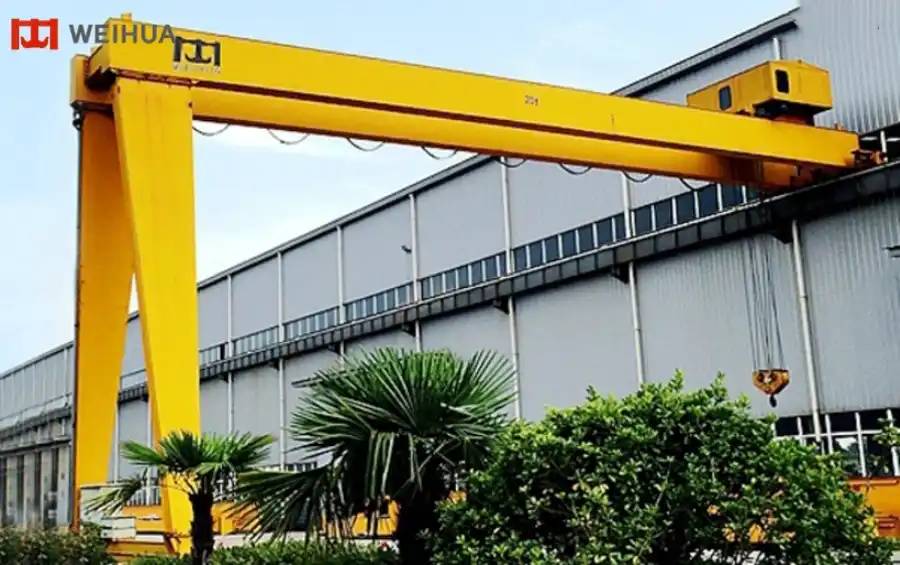
The Biggest Advantage: One Side of the Floor Stays More Open
Floor space is often the main reason customers choose a Semi-Gantry Crane.
With a full gantry crane, both sides need ground-level supporting legs and travel rails.
A semi-gantry crane removes one of those ground-supported sides.
That can make a noticeable difference in a busy workshop.
The free side can be used for:
-forklift traffic;
-truck access;
-production equipment;
-material storage;
-pedestrian routes;
-assembly stations.
This is particularly valuable when the crane operates near the edge of a workshop or along a production line.
The objective is not simply to reduce the amount of steel. It is to fit lifting equipment into an area where other machines and vehicles still need to move.
A Good Solution for Workshop Expansion
Semi-gantry cranes are also useful when a factory needs additional lifting coverage but does not want to redesign the complete workshop crane system.
For example, an existing overhead crane may already serve the main production bay.
Later, the company adds a side assembly zone or storage area.
Instead of installing another full overhead crane across the complete building, a semi-gantry crane may serve only the new work area.
This allows the lifting system to be matched to the actual production layout.
For expansion projects, the most important step is checking whether the existing building-side runway or supporting structure can carry the required crane loads.
Do not assume an existing beam is automatically suitable.
The crane reactions and structural capacity must be properly evaluated.
What Can a Semi-Gantry Crane Handle?
Typical applications can include:
-machinery assembly;
-steel fabrication;
-mold handling;
-maintenance work;
-equipment loading;
-material transfer;
-production-line support;
-warehouse handling;
-workshop-side storage areas.
The crane can be used for general industrial lifting as long as the design matches the load and working conditions.
Load shape matters.
A compact motor, a long steel component and a large fabrication assembly may all have the same weight, but they do not create the same lifting requirement.
When requesting a quotation, describe the material instead of providing only tonnage.
Useful information includes:
-maximum load weight;
-normal load weght;
-load dimensions;
-lifting points;
-center of gravity;
-required lifting attachment;
-whether the load needs to rotate or be positioned precisely.
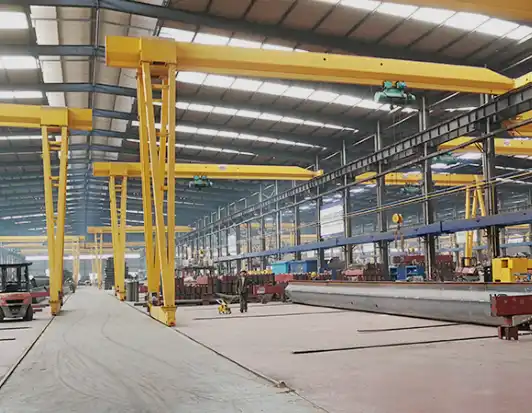
Single-Girder or Double-Girder Semi-Gantry Crane?
The answer depends on the application.
A single-girder semi-gantry crane may be considered for some moderate lifting requirements where a simpler and lighter arrangement is suitable.
A double-girder design may be more appropriate for higher loads, wider spans, heavier working duty or applications requiring a different trolley arrangement.
Neither configuration should be selected only because one looks stronger.
The correct choice should consider:
capacity + span + lifting height + duty + structural limits + required operating space.
This gives a much more reliable result than comparing crane types by appearance.
Working Duty Can Change the Whole Design
A semi-gantry crane used occasionally for equipment maintenance has a very different job from one serving a production line all day.
Operating frequency affects the selection of the lifting and traveling components.
When discussing the project, provide realistic information such as:
-operating hours per day;
-lifts per hour;
-average load;
-maximum load frequency;
-number of shifts;
-crane travel frequency;
-trolley travel frequency.
If the crane works continuously, make that clear from the beginning.
Underestimating duty to reduce initial cost is rarely a good purchasing strategy.
The crane should be selected for the real production rhythm.
Semi-Gantry Crane vs. Full Gantry Crane
Customers often compare these two options.
The main difference is structural support.
A full gantry crane is supported from the ground on both sides.
A semi-gantry crane uses one elevated support side and one ground-supported side.
A semi-gantry crane may be more suitable when:
-one side of the building can support a crane runway;
-floor space is limited;
-only part of the workshop needs crane coverage;
-a second gantry leg would obstruct production or traffic.
A full gantry crane may make more sense when there is no suitable building structure or when the crane needs to operate independently in an open yard.
The site layout usually makes the choice clear.
Semi-Gantry Crane vs. Overhead Crane
An overhead crane normally needs elevated runways on both sides.
A semi-gantry crane needs only one.
This can make it useful where one side of the building cannot provide a suitable runway or where the crane needs to extend beyond the normal workshop bay.
For customers modifying an existing facility, this difference can reduce the amount of building-side structural work required.
However, the ground rail and supporting foundation still need proper engineering.
What Information Is Needed for a Quotation?
A useful Semi-Gantry Crane inquiry should contain more than just lifting capacity.
Send the following information if available:
Lifting capacity
Maximum load the crane must handle.
Span
Distance between the elevated rail and ground rail.
Lifting height
Required hook travel or required hook position above the floor.
Travel length
Total length of the crane runway.
Load details
Material, dimensions, lifting points and typical weight.
Working frequency
Operating hours, lifts per hour and number of shifts.
Building information
Elevated runway position, structural drawings and available clearance.
Ground-side information
Rail location, foundation condition and floor layout.
Power supply
Local voltage, frequency and phase.
Environment
Indoor, outdoor or mixed conditions.
Project location
Country and installation site.
Photos and layout drawings are strongly recommended for retrofit projects.
